14.1 Straight Pool Rules: The Complete Guide
Fifteen balls, every one worth a point, and a game that never has to end — the official rules behind pool's original marathon.
Straight pool — officially 14.1 continuous — is the game professional pool was built on. Every ball is worth a point, every shot is called, and when fourteen balls are down the lone survivor stays on the table while the rest are re-racked, so the run never has to end. This guide covers the official WPA rules, then why a game invented in 1910 still matters.
What is the object of the game?
Straight pool is a call-shot game: before each shot you name the ball and the pocket, and every legally pocketed called ball scores one point. Any extra balls that drop on the same legal stroke score a point each too. The game is played to an agreed target — traditionally 100 points, with tournament matches often set higher — and the first player to reach it wins.
You stay at the table as long as you keep pocketing called shots. Miss, foul or call a safety, and the inning passes to your opponent.
How do the rack and the break work?
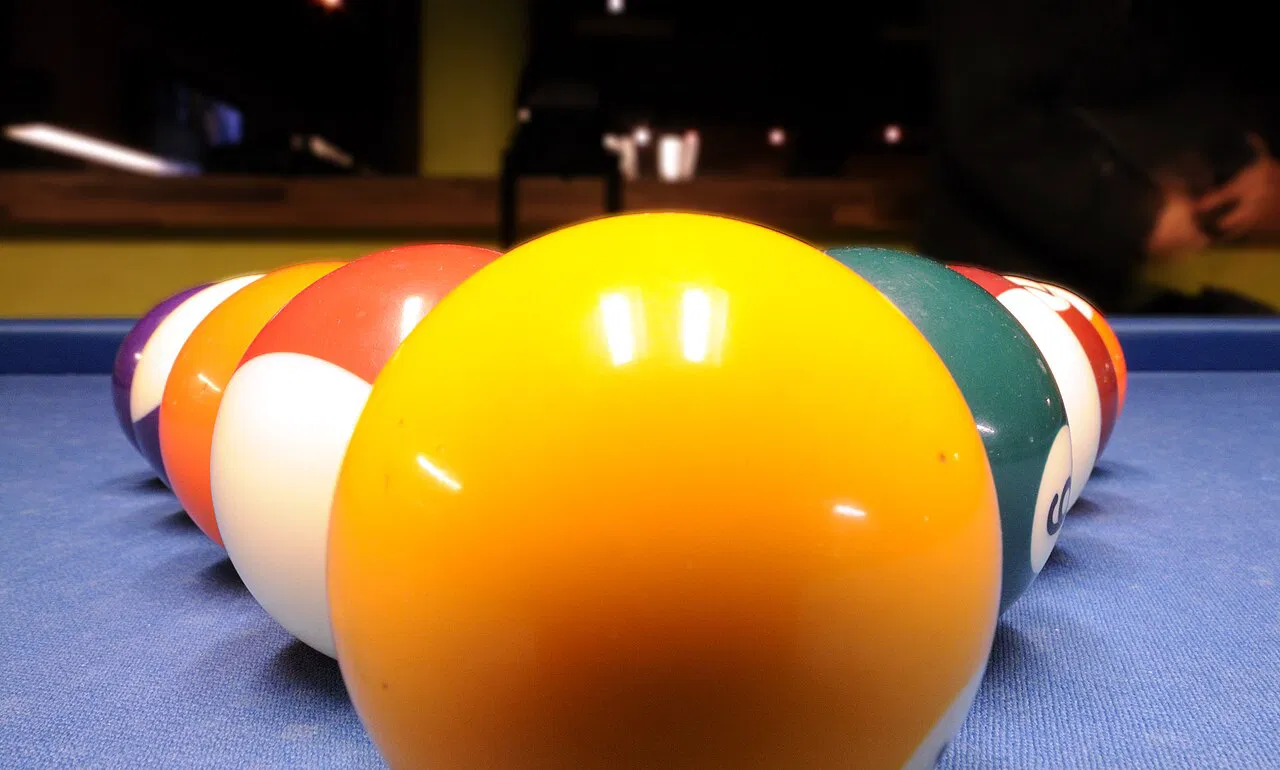
- Fifteen balls go in a standard triangle with the apex ball on the foot spot; players lag for the break.
- The cue ball starts in hand behind the head string.
- On the opening break you must either pocket a called ball or drive the cue ball and two object balls each to a rail. Fail that and it's a breaking foul: -2 points, and the non-breaker can take the table as it lies or make you break again until you satisfy the requirement.
That's why a straight pool break looks nothing like 9-ball — it's a soft, deliberate shot, and the two-point penalty exists to keep it honest.
How does scoring work?
- +1 point for each legally pocketed called ball — including extra balls that drop on the same stroke.
- -1 point for a standard foul and -2 for a breaking foul; fouls can push your score negative.
- Balls pocketed on fouls, on called safeties, or with no called ball pocketed are spotted — they never count.
You can also call "safety" at any time: your inning simply ends and anything you pocket on the shot comes back up. The option to end your own turn on purpose is the heart of straight pool tactics.
What happens when fourteen balls are down?
This is the "continuous" part. Once fourteen balls have been pocketed, play pauses while they are re-racked — with the apex position left open — and the fifteenth ball stays where it lies. The shooter then continues, ideally pocketing that last ball while the cue ball crashes into the new rack and spreads it. Players call that fifteenth ball the break ball, and long runs are built on planning a rack ahead to leave one.
If the cue ball or the fifteenth ball lands inside the rack area, the rules sort it out mechanically: the fifteenth ball pocketed on the same shot as the fourteenth means a full fifteen-ball re-rack; both balls interfering means a full re-rack with the cue ball in hand behind the head string; only the object ball interfering sends it to the head spot (the center spot if blocked); and only the cue ball interfering puts it in hand behind the head string — or spots it on the head or center spot, depending on where the object ball sits.
What counts as a foul?
A standard foul costs one point, the affected balls are spotted, and the cue ball stays where it lies — there is no ball-in-hand-anywhere in 14.1. The big exception is a scratch: a cue ball pocketed or driven off the table gives the incoming player ball in hand behind the head string. Standard fouls include:
- Cue ball scratched or driven off the table
- No rail after contact when nothing is pocketed
- An object ball driven off the table — it's spotted back
- Touched ball, double hit or push shot
- Shooting while the balls are still moving
- No foot on the floor, or playing out of turn
Two wrinkles matter:
- Breaking fouls are their own category — two points and a possible re-break, and they don't count toward the streak below.
- Three consecutive fouls by the same player trigger the heavy penalty: the usual -1 for the third foul, an additional -15 points, a full re-rack, and the offender must shoot under the opening-break requirements. It's what makes repeated intentional fouling ruinously expensive.
One kitchen rule worth knowing: with ball in hand behind the head string you can't shoot at an object ball that is also behind the line — if every object ball is back there, the one nearest the head string gets spotted.
Why does a game from 1910 still matter?
Jerome Keogh invented straight pool in 1910 by tweaking the older continuous pool — leaving one ball up between racks is what opened the door to endless runs. It was the professional game for most of the twentieth century, the setting of The Hustler, and the stage for Willie Mosconi's 526-ball run in 1954 — still the benchmark every record chase is measured against. The World Straight Pool Championship ran from 1911 to 1990 and again from 2006 to 2019, and the game lives on at events like the International Straight Pool Open and the European Pool Championships.
For league players it's also the purest practice there is: calling every shot and manufacturing break balls builds exactly the cue-ball control and pattern thinking that wins 8-ball and 9-ball matches.
Common questions
Do you have to call every shot in straight pool?
Yes — it's a call-shot game. Combinations, banks, kisses and caroms all have to be declared; obviously intended shots may not need a formal call, but the referee's judgment governs. Declaring "safety" instead ends your inning, and any ball pocketed on the safety is spotted.
What happens if you scratch?
A scratch is a standard foul: -1 point, and your opponent gets cue ball in hand behind the head string — not anywhere on the table.
Can your score go below zero?
Yes. Foul penalties subtract from your score, so early fouls can leave you in negative numbers.
Why is it called 14.1?
Because of the re-rack: fourteen balls are pocketed, one stays on the table, the fourteen go back in the triangle and the run continues.
What is the highest run ever made?
Willie Mosconi's 526 consecutive balls, set in a 1954 exhibition in Springfield, Ohio, remains the benchmark — the number every modern high-run attempt is measured against.
Is straight pool still played professionally?
Yes — the World Straight Pool Championship ran from 1911 to 1990 and returned from 2006 to 2019, and the game is still contested at events like the International Straight Pool Open and the European Pool Championships.
This guide follows the WPA Rules of Play (§7 14.1 Continuous Pool). Casual and house games often differ — always check the rules in force where you play. Cover photo: "Multi Colour Pool Balls in Triangle" by Stuart Kerr, CC BY 2.0, via Wikimedia Commons.