Three-Cushion Billiards Rules: The Complete Guide
Three balls, four cushions, zero pockets — how the world's most demanding cue sport works.
Three balls, four cushions, zero pockets — the rules of three-cushion billiards, the carom game where the rails are part of the score.
No pockets and only three balls — and a point means making your cue ball touch both other balls after at least three trips to the cushions.
If you have ever walked into a billiard room in Europe, Asia or Latin America and seen a full-size table with no pockets at all, you were looking at a carom table — and the game played on it was almost certainly three-cushion billiards, also called 3-cushion or carambole. It is the most played carom discipline in the world, governed internationally by the Union Mondiale de Billard (UMB) rather than the WPA, which runs pocket pool. The official rules fit on one card; the shots they demand take a lifetime.
What is three-cushion billiards?
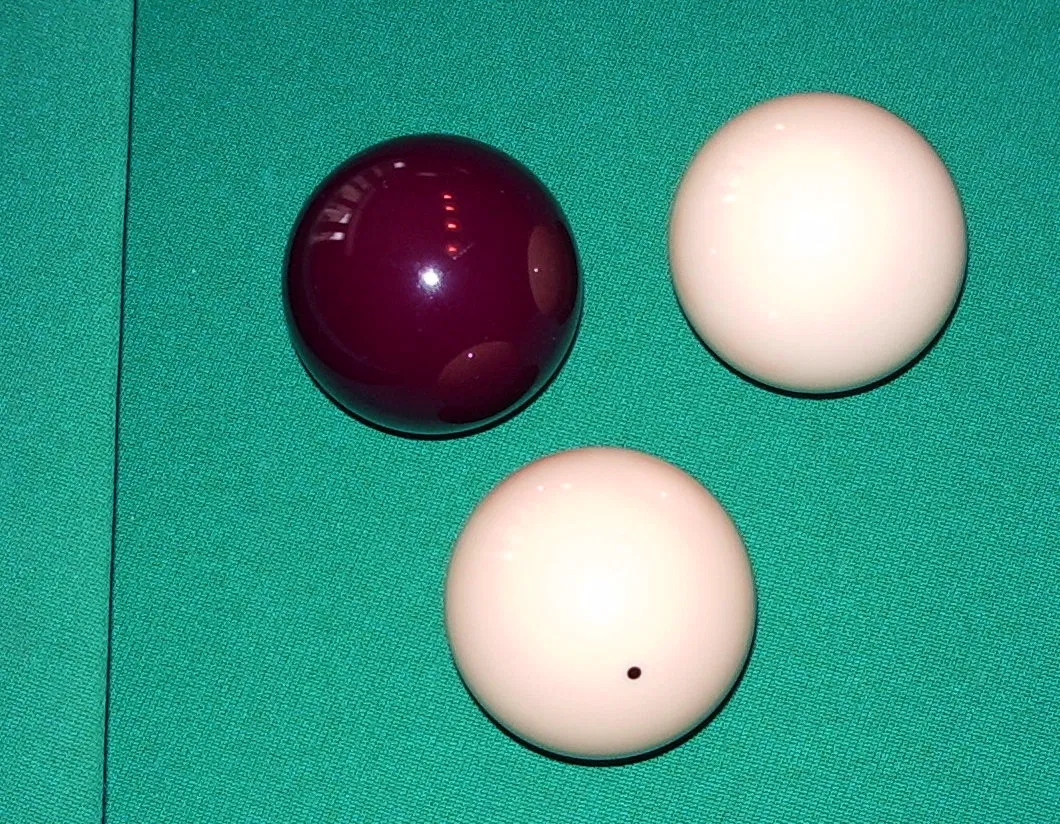
Three-cushion is a carom game: there are no pockets and no ball groups — just three balls on the table. Each player uses one of two cue balls (plain white, and yellow or a white marked with spots); the third ball is red and always an object ball.
A point — called a carom or billiard — is scored when the shooter's cue ball contacts both object balls in a single shot. Three-cushion adds one condition: before the cue ball reaches the second object ball, it must have contacted cushions at least three times. Fail either condition and the inning simply ends — no score, hand the table over.
- The three cushion contacts may happen in any order: before the first object ball, between the two ball contacts, or split between them.
- They do not have to be three different cushions — three impacts on one or two cushions count the same.
- Either object ball may be hit first, and each may be contacted any number of times.
- A shot is complete only when all three balls have stopped moving or spinning.
What does the table look like?
A competition carom table has roughly 5 × 10 feet (2.84 × 1.42 m) of playing surface — larger than a home pool table — with no pockets; the cushions run unbroken around the frame. Tournament tables are heated, which keeps the cloth dry and the rebound of the rails consistent from day to day.
The balls are also larger than pool balls — about 61.5 mm against pool's 57 mm. Small spots printed on the cloth at the head, center and foot of the table mark ball placements, and the diamonds inlaid along the rails are not decoration: they are the coordinate system players use to calculate multi-rail paths.
How does a game begin?
Players lag for the break: each strokes a ball from the head string to the foot cushion and back, and the ball coming to rest nearer the head cushion wins. The winner may break or assign the break to the opponent, and chooses which cue ball to use for the whole game.
For the break shot the balls are set:
- the red on the foot spot;
- the opponent's cue ball on the head spot;
- the shooter's cue ball on one of the two marked spots 18.25 cm (about 7 3/16 in) left or right of the head spot.
The cue ball must be driven at the red first, directly — contacting the opponent's ball or a cushion first is a foul and the inning ends. From the second shot onward, either object ball may be played first.
How is the game scored?
Every valid carom is worth one point, and the shooter keeps the table until a shot fails to score. There are no ball values and no penalty for a missed count — the structure encourages playing for the point every time. Games run to a set total — 40 or 50 points at major UMB events — and when the starting player reaches the target, the opponent receives one equalizing inning to try to draw level.
Because a single point is genuinely hard, a player's level is measured as an average: points divided by innings. Averaging 1.0 — a point every turn — is already national-level play; 1.5 or better is world-class.
What counts as a foul?
Nearly every foul in three-cushion simply ends the inning, with the balls left where they lie. The main list, after the USBA rules that mirror the UMB game:
- Break foul — the cue ball not contacting the red first on the break
- Wrong ball — shooting with the opponent's cue ball; points made before the foul is noticed still count
- Touched ball — contacting any ball with hand, clothing, cue or a piece of chalk
- Jumped ball — any ball leaving the table; balls are re-spotted: red on the foot spot, the shooter's cue ball on the head spot, the opponent's on the center spot
- Frozen-cushion shot — when the cue ball rests frozen to a rail, playing directly into that rail is a foul; it must come off the cushion first (a masse away and back is legal)
- Push shot or double stroke, shooting while the balls are still moving or spinning, ferrule or shaft touching the cue ball, touching the cue ball during warm-up strokes, and having no foot on the floor at the moment of the shot
- Riding the frame — a ball that rides a rail and returns counts one cushion contact per rail; a ball that touches the wooden frame or comes to rest on a rail is a foul
- Intentional safety — under USBA rules, deliberately playing safe is itself a foul; the incoming player may take the balls as they lie or restore the break position
Kiss shots are always fair, whether they help or hurt, and a miscue is a foul only if the ferrule or shaft touches the cue ball.
How is it different from pool?
| Pocket pool (WPA rules) | Three-cushion (UMB rules) | |
|---|---|---|
| Pockets | Six | None — cushions run unbroken |
| Balls | Cue ball + 7–15 object balls | Three total: two cue balls + red |
| A point is | A pocketed ball or a won rack | A carom: cue ball touches both object balls |
| The rails | A position tool | Part of the scoring requirement |
| Safeties | Central strategy | Not the object — every shot tries to score |
| Governing body | World Pool Association | Union Mondiale de Billard |
Why is it worth learning?
Three-cushion dates to the 1870s in St. Louis, outlasted balkline to become the world-championship carom game, and remains the dominant cue sport across much of Europe, Asia and Latin America — with a UMB World Championship, a World Cup circuit and a place at the World Games. For a pool player it is the purest cue-ball-control laboratory there is: every shot is a position play measured in rails, and the diamond systems it teaches quietly upgrade your pocket game too.
Common questions
What is the pool game with no pockets called?
Carom billiards — and its most played form is three-cushion, where a point requires the cue ball to contact at least three cushions before touching the second object ball.
How many balls are used in three-cushion billiards?
Three: two cue balls (white, and yellow or a spotted white) and a red object ball. Each player shoots the same cue ball for the whole game; the red is always an object ball.
How do you score a point?
The cue ball must touch both object balls in one shot, with at least three cushion contacts before it reaches the second object ball. The three impacts can be on one, two or three different cushions, in any order.
What happens on a foul?
The inning ends and the balls stay where they lie. Any ball that left the table is re-spotted — red on the foot spot, the shooter's cue ball on the head spot, the opponent's on the center spot.
Can you play a safety shot?
Under USBA rules an intentional safety is a foul — the opponent may take the balls as they lie or ask for a fresh break position. Under UMB international rules every shot is simply expected to try to score.
Is three-cushion the same as snooker or English billiards?
No — snooker and English billiards are played on pocketed tables. Carom games (three-cushion, one-cushion, straight rail, balkline) are played on a pocketless table and governed by the UMB.
This guide follows the UMB Carom Billiards Rules (Art. 83, three cushions) and the USBA Three-Cushion Rules of Play. Casual and regional games can differ — always check the rules in force where you play. Cover photo: "Carom billiards balls" by SMcCandlish, CC BY-SA 4.0, via Wikimedia Commons.