Snooker Rules: The Complete Guide
Fifteen reds, six colors and one cue ball on a 12-foot table — how snooker, the world’s most-watched cue sport, actually works.
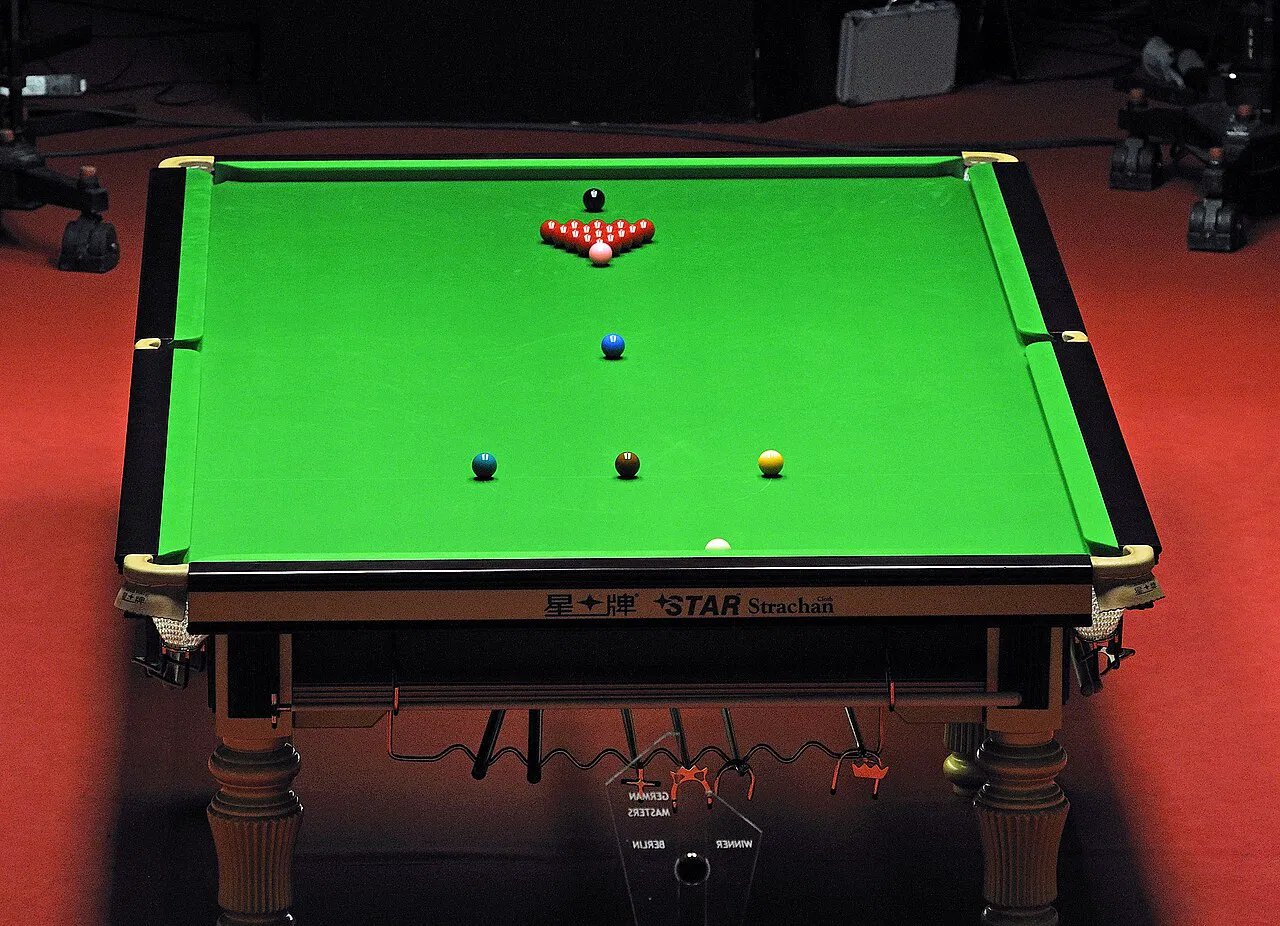
Snooker is the most-watched cue sport on the planet — a scoring battle on a 12-foot table where 15 reds and six colors have to be cleared in a fixed rhythm, and a single safety mistake can hand over a frame-winning visit. Governed worldwide by the WPBSA, its rulebook is stricter than pool's in ways that surprise newcomers: there is no ball in hand after most fouls, missed escape shots can be replayed from the start, and potted balls keep coming back onto the table. This guide walks through the official rules from the break to the respotted black.
What is the object of the game?
A frame of snooker is a straight scoring contest: two players share one table and whoever finishes with more points wins the frame. Matches run to a set number of frames — best of 7 in club events, best of 35 in the World Championship final.
The ammunition is 22 balls: a cue ball, 15 reds worth 1 point each, and six colors — yellow (2), green (3), brown (4), blue (5), pink (6) and black (7). There are no ball groups, no rotation order and nothing to call — you score for as long as you keep potting legally.
How is the table set up?
A full-size snooker table measures 12 × 6 feet — much bigger than a pool table — with six pockets and tight, rounded pocket jaws. The baulk line crosses the table near one end, and the "D", a semicircle drawn on the baulk line, is the only place the cue ball may be played from when it is in hand.
At the start of a frame:
- the 15 reds sit in a tight triangle behind the pink spot, the apex red as close to the pink as possible without touching it;
- the black goes on its spot near the top cushion, the pink midway between center and top, the blue dead center;
- brown, green and yellow sit on the baulk line — brown at center, green on the left and yellow on the right as you face the table from the baulk end;
- the cue ball starts anywhere inside the D, and the first shot must contact a red.
How does a visit work?
Players alternate turns, and your turn — a visit, and the points scored in it, a break — continues as long as you keep potting. The scoring sequence is the heart of the game:
- While any red remains, the first shot of every visit must hit a red — the ball on.
- Pot a red and it stays down; your next shot is on a color you nominate, and if it drops it is re-spotted on its own spot (or the highest-value free spot if its own is occupied).
- Alternate red → color → red → color until the last red is gone.
- After the final red you pot one last nominated color — it is re-spotted — and then the colors must be taken in order yellow, green, brown, blue, pink, black, this time staying down for good.
The biggest possible scoring run is therefore 15 reds, 15 blacks and all six colors: 147 points, the maximum break.
What counts as a foul — and what does it cost?
Snooker rarely uses ball in hand; instead a foul awards penalty points to your opponent — the value of the ball on, or of the highest-value ball involved in the foul, whichever is higher, with a minimum of 4 points. The main fouls:
- Hitting a ball not "on" first, or failing to contact any ball
- Potting the cue ball (an in-off) or potting a ball not on
- Any ball driven off the table
- Push stroke — tip still on the cue ball as it reaches the object ball — or striking the cue ball twice
- Touching any ball with hand, clothing, a rest or a piece of chalk
- Playing out of turn, or striking with both feet off the floor
After an in-off the cue ball is in hand from inside the D; after most other fouls the incoming player takes the table as it lies — or can make the offender play again from where the balls stop.
What are a miss, a free ball and a touching ball?
Three snooker ideas have no real equivalent in pool:
- Foul and a miss. Fail to hit a ball on and the referee may call a miss — a judgment that you did not make a good enough attempt. Your opponent can then have the balls restored to their original positions and make you try the shot again. The rule exists to punish escapes that gain an advantage from thin or lucky contact.
- Three-miss forfeit. If the cue ball can reach a ball on full in the face in a direct line and you miss it three visits in a row — after a warning — the frame is awarded to your opponent.
- Free ball. If a foul leaves you snookered on every ball on — unable to hit both extreme edges of one in a straight line — the referee calls free ball: you may nominate any ball as the ball on. It scores as the ball on (1 point while reds are on) and is re-spotted like a color.
- Touching ball. If the cue ball comes to rest touching a ball on, the referee calls touching ball; you must play away from it without moving it, and you are treated as having already struck it.
How does a frame end?
A frame ends when the black is potted as the last ball, when a player concedes, or — once only the black remains — on the next scoring shot or foul. If the scores finish level, the black is re-spotted and the players draw lots for the cue ball in hand from the D: the respotted black, a one-ball shootout settled by the first pot or foul.
Common questions
How many balls are used in snooker?
Twenty-two: a cue ball, 15 reds and six colors — yellow, green, brown, blue, pink and black.
What is the highest possible break?
147 — 15 reds each followed by the black (15 × 8 = 120) plus the six colors in order (27). An early free ball can theoretically stretch it to 155.
Why do potted colors come back onto the table?
While any red remains, a potted color is re-spotted so it can be played again after the next red — that alternation is the engine of a snooker break. Only the closing sequence, yellow through black, stays down.
What happens when the cue ball is potted?
An in-off: penalty points to your opponent (minimum four, or the value of the ball on if higher) and the cue ball is in hand from anywhere inside the D.
What is a free ball?
If a foul leaves you snookered on every ball on, the referee awards a free ball — for that one shot you may nominate any ball as the ball on.
What is a respotted black?
When a frame ends tied on points, the black goes back on its spot and the players take turns with the cue ball in hand from the D; the first pot or foul decides the frame.
This guide follows the WPBSA Official Rules of the Game of Snooker and English Billiards. Amateur and handicap games can differ — always check the rules in force where you play. Cover photo: "German Masters Snooker Final" by DerHexer, CC BY-SA 4.0, via Wikimedia Commons.