Cutthroat Pool Rules: The Complete Guide
Pocket everyone else’s balls and keep yours alive - the official rules behind pool’s best three-player game.

Every ball you sink belongs to somebody else — the last player with a ball still on the table wins. The official rules of cutthroat, pool's three-player survival game.
Cutthroat — also called Elimination — is the rare pool game built for an odd number of players: three (or five) shooters each defend a group of balls while trying to knock out everyone else's. It plays fast, needs no scorekeeping, and is the standard answer to "we're three, what do we play?" This guide follows the official BCA World Standardized Rules for Cut-Throat, plus the house variants you will actually meet.
What is the object of the game?
Fifteen object balls split into fixed groups — and your job is inverted from normal pool. You pocket the other players' balls, not your own. The last player with at least one ball of their group still on the table wins. Group balls carry no point value; survival is the only score.
How do the rack and the break work?
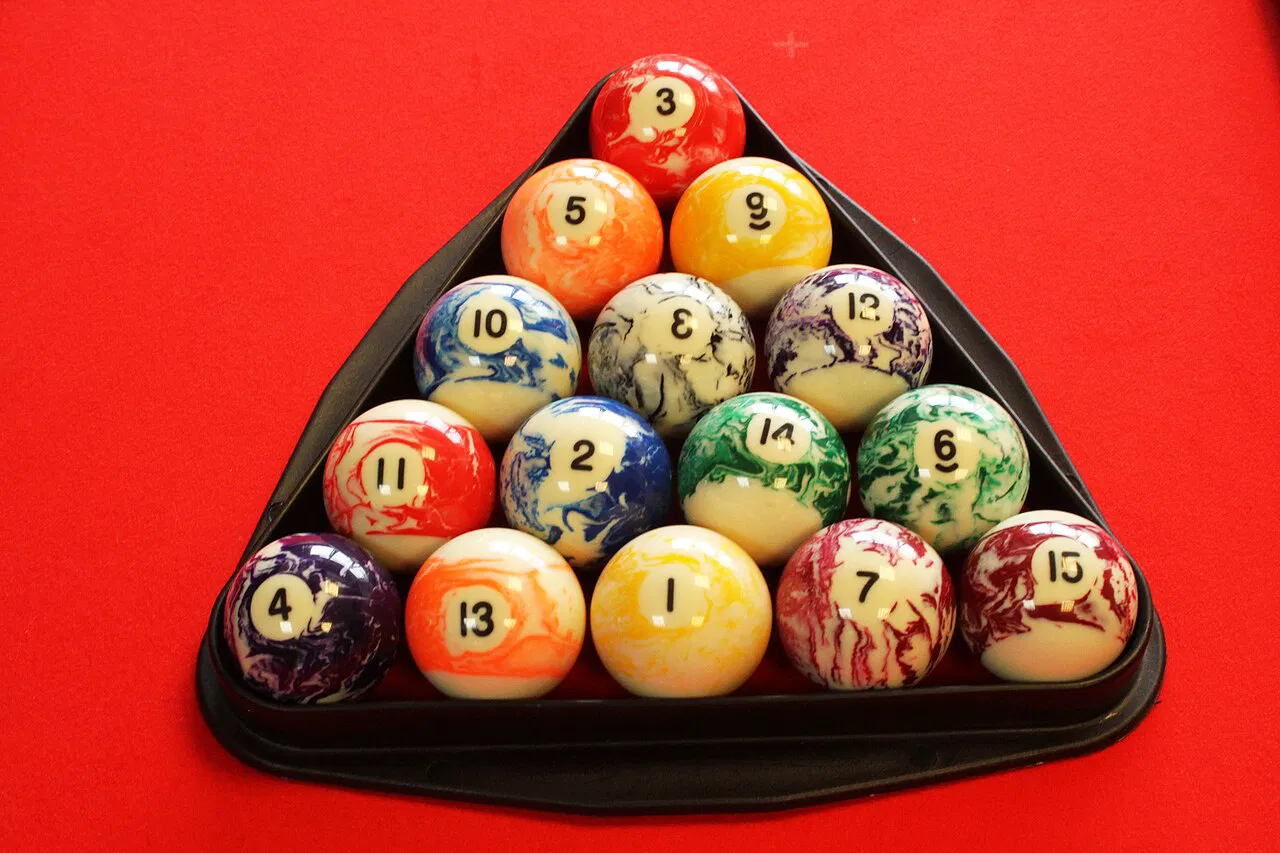
- Standard triangle rack: the 1 ball on the foot spot and the 6 and 11 on the two back corners; every other ball placed at random.
- The starting player must make an open break. Fail that, and the incoming player chooses: accept the table as it lies and shoot, or have the balls re-racked and take the opening break themselves.
- Balls pocketed on a legal break stay down — a group can shrink before its owner has ever shot.
How are the ball groups assigned?
In the official three-player game the groups are fixed by order of play: the starting player owns 1–5, the second shooter 6–10, the third 11–15. In five-player games the split tightens to three balls each: 1–3, 4–6, 7–9, 10–12 and 13–15.
What makes a shot legal?
Two requirements on every stroke:
- The cue ball's first contact must be an opponent's object ball — you may never open a shot on your own group.
- After contact, either a numbered ball is pocketed or any ball (including the cue ball) reaches a cushion. Miss both and it is a foul.
Pocket a ball legally and you keep shooting until you fail to score. Whether shots must be called — as in 8-ball — is left for the players to agree on beforehand; the official rules make call shot optional in cutthroat.
What happens on a foul?
The penalty is what makes cutthroat cutthroat. On any foul — a scratch, no rail after contact, wrong first ball:
- Your inning ends.
- One ball from each opponent's group that is off the table is spotted back. A single scratch can resurrect both rivals at once.
- If an opponent has no pocketed balls yet, the penalty simply does not apply to them — it is not carried forward.
- After a scratch or a cue ball driven off the table, the incoming player has ball in hand behind the head string. If every opponent ball also sits behind the head string, the shooter may ask for the nearest one to be spotted on the foot spot — their choice when several sit equidistant.
- Object balls jumped off the table are all spotted, the stroke is a foul, and the incoming player accepts the cue ball in position.
How do elimination and reinstatement work?
Lose your last group ball — even on your own foul, since your own balls pocketed on an illegal shot stay down — and you are out of the rotation. But elimination is rarely permanent: the moment any player still in the game fouls, one of your pocketed balls comes back and you re-enter in your original order. That is the swing that defines the game: a player one scratch from victory can hand the table straight back.
The mirror-image rule keeps it honest: an opponent's ball pocketed on an illegal shot is spotted with no further penalty, while your own stay down. And the next game's order writes itself — the first player eliminated breaks, the winner shoots last, everyone else in the order they went out.
Why is cutthroat the three-player game?
Nearly every codified pool discipline is heads-up — 9-ball, 10-ball, bank pool, one-pocket, even 14.1. Cutthroat is the rulebook's odd one out: an every-player-for-themselves ring game where each turn means choosing whose balls to attack and whose to leave alone. Officially a social game rather than a tournament discipline, it is the closest pool comes to three-handed poker.
Common questions
How many people can play cutthroat?
Three or five under the official rules. With three players each owns five balls (1–5, 6–10, 11–15); with five, three balls each (1–3 through 13–15).
Do I have to call my shots?
Only if the players agree to it before the game. The official rules make call shot optional, and most casual games play without it.
What happens when someone scratches?
Their turn ends, the incoming player gets ball in hand behind the head string, and — the painful part — one pocketed ball from each opponent's group is spotted back on the table.
Can an eliminated player come back?
Yes. Whenever a player still in the game commits a foul, one ball is spotted for each opponent, which returns eliminated players to the rotation in their original order.
Is it a foul to hit my own balls first?
Yes. A legal shot requires the cue ball's first contact to be with an opponent's object ball. And any of your own balls that drop on an illegal shot stay down — the foul hurts you twice.
Who breaks in the next game?
The first player eliminated in the previous game. The winner of that game shoots last, and everyone else shoots in the order they were eliminated.
This guide follows the BCA World Standardized Rules for Cut-Throat — the General Rules of Pocket Billiards apply except where contradicted. House and league rules often differ, so check the rules in force where you play. Cover photo: "A focused woman in a blue dress racks the balls on a pool table under colorful bar lights" by PattayaPatrol, CC BY-SA 4.0, via Wikimedia Commons.